Do you suffer from jaw clenching or teeth grinding? Try the following exercises to reduce your bruxism symptoms
Bruxism exercises
A tense jaw can lead to discomfort and pain, and is often a symptom of stress or bruxism. Fortunately, there are several simple exercises you can do to relax your jaw muscles. You can try the following exercises:
Jaw relaxation exercise
Open your mouth slowly and as wide as is comfortable. Then you slowly close your mouth again. Repeat this a few times. Make sure the movement is smooth and without tension. This exercise helps reduce tension in the jaw muscles and promotes natural jaw movement. also look at Gea's review who noticed a clear difference after 2 weeks by using the Re-mind for Bruxism!.
Jaw stretching exercise
Place the tip of your tongue against the roof of your mouth just behind your top teeth. Open your mouth slowly while keeping your tongue in this place. Hold this position for a few seconds and then slowly close your mouth.
This exercise helps to stretch the muscles around the jaw and can help reduce back pain jaw muscle pain.
Lateral Jaw Movement
Keep your mouth slightly open and gently move your jaw from side to side. Do this slowly and without force. This exercise helps improve the flexibility of the jaw muscles and can reduce stiffness.
Chin lift
Stand or sit upright and slowly tilt your head back, looking at the ceiling. Gently push your chin forward. You will feel a slight stretch in the jaw and neck. Hold this position for a few seconds and then return to the starting position. This exercise helps to relax the muscles of the neck and lower jaw, which can indirectly contribute to the relaxation of the jaw muscles.
Relaxation by breathing calmly
Close your eyes and breathe deeply and slowly. Focus on relaxing your jaw muscles with each exhale. This breathing exercise helps reduce overall stress and tension, which can also reduce tension in the jaw. Becoming aware of breathing and relaxation exercises are also good against jaw clenching, for example. You probably know the expression 'just grit your teeth'. This is often used in preparation for something painful to come, such as an injection or a stitch. Actually, this also happens unconsciously when you clench your jaw. Sometimes you are so busy with something that you don't even notice it. That is why it is a good idea to live life as relaxed as possible. The exercises below will help with this. Did you also know that VGZ is a Mindfulness App has a lot of exercises!
Exercise by speech therapist and Yoga and respiratory therapist Yolande Kylstra
To If you feel less agitated and more relaxed and energetic in the evening, it is wise to take a break more often during the day. After step 1 (awareness) you can regularly alternate the adjustment exercises with a breathing or relaxation exercise (step 2).
Step 1:
Try the following exercises during the first week to become aware of what you are actually doing.
Let the re-mind vibrate every 6 or 12 minutes and check:
- Do I breathe through my mouth or nose?
- What is my posture: are my shoulders raised?
- Am I creating tension in my jaws?
- Do I keep my stomach pulled in?
- Do I sit on both buttocks?
- Are both feet on the ground?
- What is the expression on my face, am I relaxed?
- Where do I feel the greatest breathing movement, in my stomach or chest?
- Am I holding my breath?
If, after this first week, you are well aware of what you are doing, you can do something about it:
- Check that your mouth is closed with your tongue against the roof of your mouth (and that you are breathing through your nose). If not, change that.
- Check that you are sitting upright. If not, change that.
- Feel if you are creating tension somewhere that is not functional and release it.
- Feel if you are holding your breath. Is your stomach also contracted? Release!
- Feel the expression of your face. Are you creating tension in your forehead or jaws? Release!
- Feel your shoulders. Did you pull them up? Release!
- Feel if you are sitting on both buttocks. If not, change that.
- Feel whether both feet touch the ground. If not, change that.
step 2:
The next step is to use the re-mind and start practicing. Let the re-mind vibrate every 6 or 12 minutes and alternate the exercises:
- Place your hand on your stomach. Bring your attention to your hand. Feel the breath follow.
- Bring your attention down. Become aware of your buttocks on the chair and/or your feet on the floor.
- Take a deep breath in through your nose and a long breath out through your mouth
- Yawn
- Stretch yourself, make yourself completely tall
- Take turns stretching out your arms (“apple picking”)
- Pull your shoulders toward your ears and let go completely
- Look over your shoulders a few times
- Rotate your shoulders forward and back
- Completely round your back and remain seated for a moment, breathing. Then make your back long and hollow, look up and sit there for a moment while you breathe. Return to a straight position.
If you want help learning to relax, take a look at the website from Yolande.
10 quick exercises for behind your desk
The re-mind vibrates, what now? You are not ready for a longer break yet. That's okay, a short, quick exercise every 6 minutes also helps against a stiff neck, back or shoulders. As long as you break your static position for a moment. Ten examples:
- Rotate in circles with your shoulders back
- Stand up for a moment
- Stretch and arch your back
- Rotate your arms backward (back crawl movement)
- Stretch your arms up one by one
- Sit (again) against your backrest
- Look behind you, left and right
- Bring your ear to your shoulder and hold for a moment, first left and then right
- Bring your shoulder blades strongly back and down, ensure a long neck
- Check for unnecessary body tension (for example hunched shoulders) and reduce it.
Keep repeating the exercises
Persistence really pays off. So perform these exercises regularly. Do not force movements and stop if you experience pain. Combine these exercises with relaxation exercises. Performing these exercises regularly can help reduce tension in the jaw. If jaw tension persists or becomes painful, it is advisable to consult a medical professional.
The re-mind helps you become more aware of your behavior!
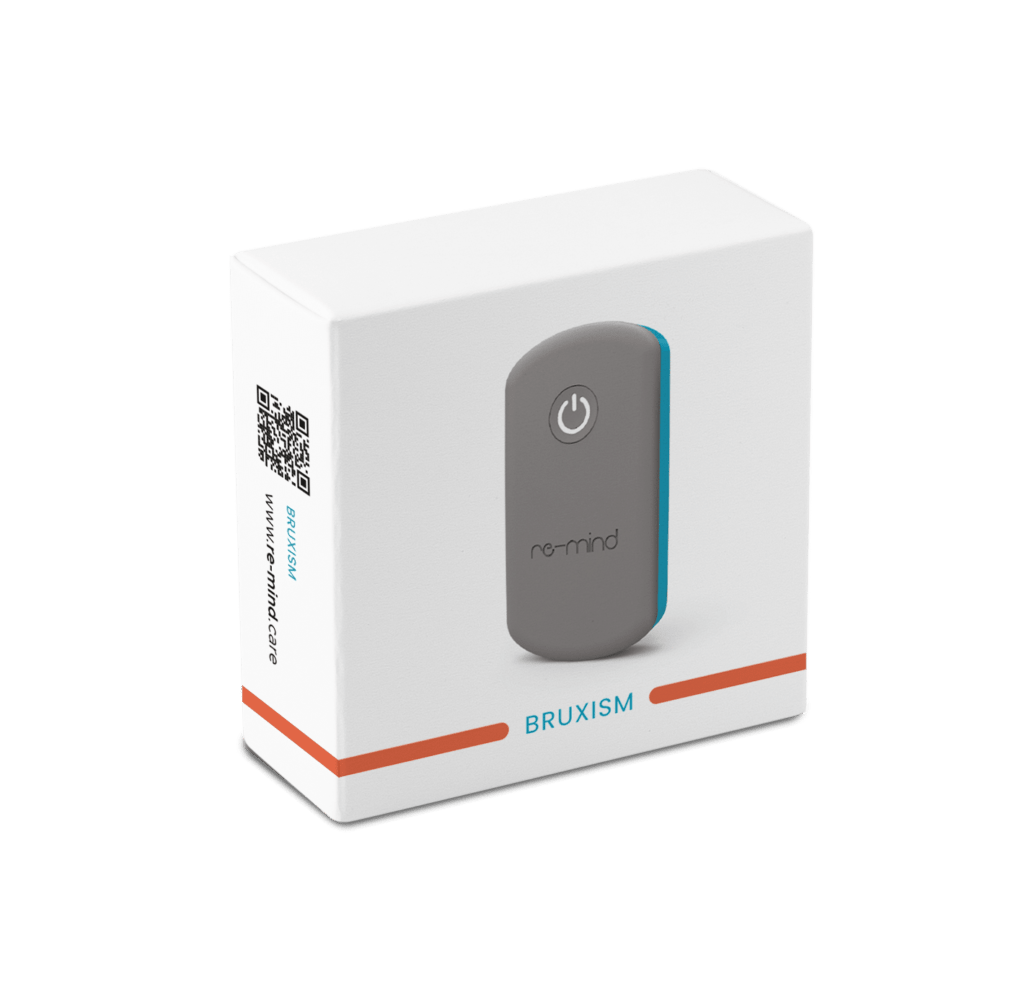
There is an innovative solution for people who suffer from waking bruxism: the re-mind. This helps you to become aware of your grinding and clenching behavior. With a gentle vibration, the re-mind reminds you to relax your jaw and thus eliminate clenching and grinding. You can re-mind Bruxism easily and quickly via this website to order.